
Shame and ADHD: leaving society’s oldest control programming and returning to the body


Would you rather listen than read? Get actionable tools from the Unstuck Minds podcast:
In the first episode of Unstuck Minds, I sat down with Silvia Cosma, Thrive Collective co-founder, to discuss ADHD, shame, and how breathwork can help break the spiral of shame.
Click the play button to receive personal insights, actionable tools, and answers to community questions - who knows, maybe that question you've been secretly asking yourself got answered here already:

Do you want to dive deeper into shame and ADHD?
Read the article below, and start moving from shame to self-love as an ADHD'er:
Shame: the efficient software human society installed at scale
Shame is one of humanity’s stickiest social tools. Not fire. Not the wheel. Shame.
Long before laws, contracts, or institutions, shame kept people in line. It signaled when behavior risked rejection and exclusion. In early human groups, that mattered. Belonging wasn’t optional. It was survival.
In the beginning, shame said: “make sure you stay connected, or die”. Even when it meant suppressing parts of yourself.
Nowadays, shame continues to run the show for many of us, even when we don’t even realize it. Both women and men get it, just the flavor changes. But the impact? It stays the same.
Because shame is efficient, self-sustaining, and once fully installed, it runs in the background draining your energy in unseen ways- while you are convinced it’s “just your personality”
Best part is it can go on forever- until you consciously start debugging it.
How shame gets learned in childhood
No child is born ashamed. As kids, we all arrive loud, curious, emotional, impulsive, embodied, and wildly honest in this world.
But from the very moment we start to speak, think, and express our uniqueness, society starts chipping away at it.

Boys hear:
• “Don’t cry”
• “Toughen up”
• “Stop being weak”
• “Be a man”

Girls hear:
• “Be nice”
• “Don’t be so loud”
• “Don’t upset anyone”
• “Be a good girl now”
Different scripts- same message: Your natural expression is inconvenient.
For a developing child’s nervous system, this signal is very serious. Children don’t have the luxury of choosing authenticity over attachment. They adapt to stay connected, following our ancestral human patterns of survival.
So the nervous system learns to override itself. Not because it wants to, but because attachment is survival.
A child will always choose belonging over authenticity. Shame begins as a survival strategy.
Gendered shame: same cage, different paint job
In today’s world, men are shamed for feeling.
Women are shamed for wanting.
Men learn that vulnerability equals danger. Emotion becomes something to suppress, numb, or convert into anger (a socially acceptable “masculine” emotion) or productivity.
Women learn that desire equals threat. Wanting more space, money, pleasure, freedom, or power makes them selfish, dramatic, or unlovable.
Men get praised for ambition and punished for softness.
Women get praised for softness and punished for ambition.

Either way, the body learns: parts of you are not allowed here. So they go underground.
Why ADHD nervous systems are especially vulnerable to shame
Now add ADHD to the mix and things escalate fast. Because ADHD systems are:
More sensitive
More expressive
Faster to feel
Slower to filter
This means when shame arrives, it doesn’t just register as a momentary thought. It registers as a long-lasting, deeply physiological event. Now put this in the context of a child who is just learning how to safely exist in the world.
A slight shift in tone, an unhappy parent’s expression, frequent correction, or withdrawal of affection – any child will notice these. But an ADHD child collides headfirst into a world obsessed with control, consistency, and enforced rules.

“Why can’t you just focus?”
“What’s wrong with you?”
“Try harder”
“You’re too much!”
“You’re lazy”
“You’re careless”
All of these build layer upon layer of “your wiring is defective”.
Because this is not occasional shaming. It is chronic.
Numbers from Psychiatrist Dr. William W. Dodson show that before they turn 12, ADHD kids hear, on average, 20.000 more corrective words from parents, teachers and peers, compared to neurotypical children.
So by the time they become adults, ADHD people don’t just feel shame when they “mess up”. Shame becomes the atmosphere they live in.
It seeps into every aspect of their identity, poisoning self-trust, and destroying their confidence.

When shame becomes the internal voice
By adulthood, no one needs to shame you anymore. You do it yourself- automatically, efficiently, and relentlessly.
You override exhaustion.
You intellectualize feelings.
You stay busy to avoid sensation.
You dissociate and call it being “emotionally regulated”.
Men numb out. Women over function. Again - it may look different but the core wound is the same.
ADHD folks somehow manage to do both, usually at the same time.
And society applauds, because you finally “fit in”. Too bad the price of admission is masking so hard, so often, that you almost inevitably burn out.
Why talk therapy often isn’t enough to regulate an ADHD system
Understanding shame intellectually can be relieving, but this is rarely enough to dissolve it. That’s because shame does not live in language. It lives in the body.
It lives in:
• Tight chests
• Locked jaws
• Aching pelvis and hips
• Collapsed posture
• Shallow breathing
• Chronic tension
• Restlessness or freeze
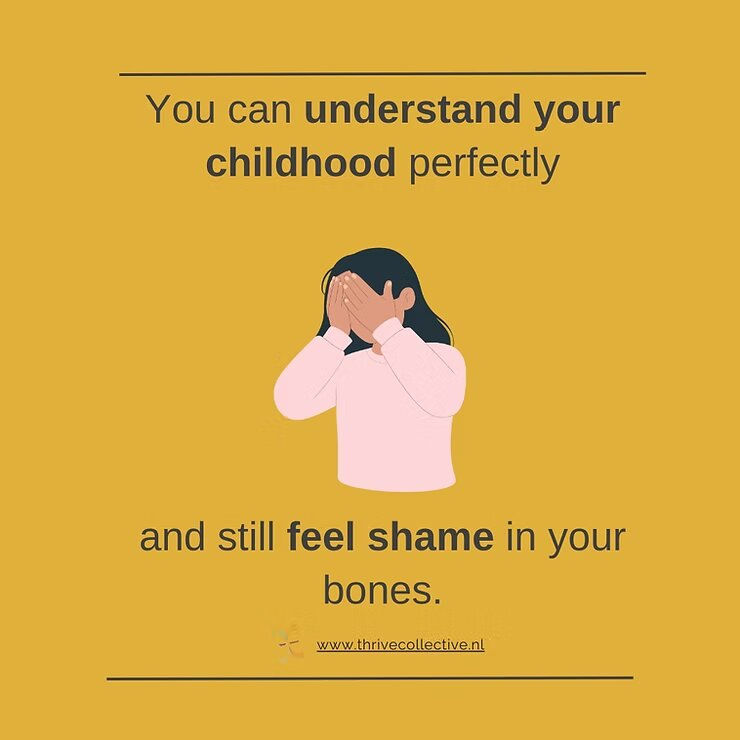
Because your body never got the memo.
How the body finds its way back
Because shame and emotional overload are stored somatically, regulation often needs to begin below language. This is where body-based approaches come in.
Somatic work (which includes breathwork) supports regulation by:
lowering physiological arousal
allowing emotions to complete their stress cycle
restoring a sense of internal safety
increasing capacity for reflection
How breathwork changes the shame game
Breath is the fastest way into the nervous system without asking permission from the conscious mind.
No, not the “breathe and calm down” nonsense. Real breathwork.
The kind that:
• Restores full exhale
• Allows sound
• Activates sensation
• Lets suppressed emotion move
• Teaches the body that intensity does not equal danger

It provides regulation without suppression. Release without collapse. Room for intensity without self-destruction.
That is what allows the body to release and process what went underground all those years ago. And it’s what allows you to integrate all the different parts of yourself that were rejected, and give them the love they crave.
Because shame dissolves when the body experiences safety in expression. Not when it understands a concept.
What I actually do as a Breathwork Practitioner (and why it works for ADHD systems)
My work is not about fixing you. Because you’re not broken. It’s about helping your nervous system complete what it learned to interrupt.
Anger that was swallowed
Grief that was postponed
Joy that was dimmed
Desire that was shamed
In my breathwork ceremonies and Rage Rituals, I bring together breath, sound, and embodiment, to guide your body through relearning that:
“I can feel this and survive.”
“I can express this and stay connected.”
“I can be intense and safe at the same time.”
When these new lessons land, and your nervous system truly integrates them, shame loses its job. Because your body no longer needs shame to feel safe.

The uncomfortable conclusion - and the reframe you need now
Shame was never personal. It was procedural.
Installed early. Reinforced often. Then quietly handed over to you to manage from the inside.
Until someone interrupted it at the level it was created.
Now, you’re on the other side. You’ve left society’s oldest control programming, and safely returned to your body.
Now you do not need permission to be exactly who you are. You don’t suppress emotion to earn belonging. You don’t rely on shame to stay connected.
Now you have a key tool to regulate your ADHD nervous system instead of playing out the same shame-driven patterns. And you are one step closer to living the life you always knew was possible for you.
Are you ready to experience this reality?
Let's have a chat - and see if we can take the first step to it together.
Lucia Pinzaru,
Breathwork specialist

Comments